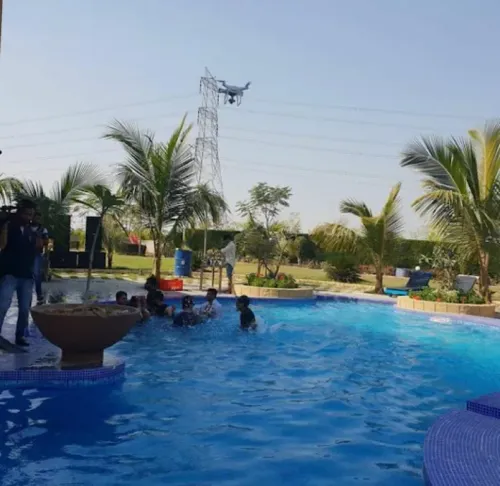
The right pool for a Nagpur farmhouse depends on how many people will use it, whether they will swim or mainly relax, and how much space remains for drainage, shade, equipment, and maintenance. By the end, you will be able to compare practical dimensions, layouts, construction methods, and site conditions before requesting a design or quotation.
Key takeaways
- Choose 8 m × 4 m for balanced family swimming and land use.
- Set pool shape and depth before adding steps, lighting, or water features.
- Plan for Nagpur’s soil, monsoon rainfall, heat, groundwater, and tree roots.
- Leave room around the pool for filtration equipment, access, and maintenance.
Start with the pool size that matches how you will use it
For most Nagpur farmhouses, 8 m × 4 m gives the best balance between swimming space, family use, and manageable land consumption. At a uniform 1.2 m depth, it holds about 38.4 m³ before steps and slopes.
Choose 5 m × 3 m for sitting, children, and cooling off; choose 12 m × 3 m or longer when swimming lengths matter. The best farmhouse pool size in Nagpur is the one your available water source, bather load, and maintenance routine can support.
| Size | Best use | Key trade-off |
|---|---|---|
| 5 m × 3 m | Compact plunge pool | Leaves more deck and needs less water, but offers limited swimming space |
| 6 m × 3 m | Small family pool | Suits casual recreation when land is tight |
| 8 m × 4 m | Family and entertaining pool | Allows several users without consuming the land needed for access and shade |
| 12 m × 3 m or larger | Lap and fitness swimming | Provides a useful straight length but gives less width for groups |
Measure the complete working area, not just the water rectangle. Reserve space for:
- A non-slip circulation deck and a clear route from the house
- Outdoor shower, changing space, and child-safe supervision
- Plant-room access, drainage, and equipment removal
- Shade, fencing, and a cover to reduce Nagpur’s evaporation and dust load
If the plot cannot provide these areas, reduce the pool before sacrificing safe circulation or filtration access. A smaller, well-maintained pool delivers more usable time than a large pool with no room for cleaning, repairs, or comfortable family use.
Choose the shape and water depth before choosing features
A rectangular pool is the safest default for a farmhouse swimming pool design in Nagpur: it uses land efficiently, simplifies covers and circulation, and gives filtration fewer awkward corners. Decide the water purpose and depth before adding ledges, spas, lights, or an infinity edge.
| Option | Best use | Main trade-off |
|---|---|---|
| Rectangular | Family recreation or straightforward swimming | Least sculptural, but easiest to cover, clean, and supervise |
| L-shaped | Separating children’s play from adult seating | Uses more deck and creates corners that complicate circulation |
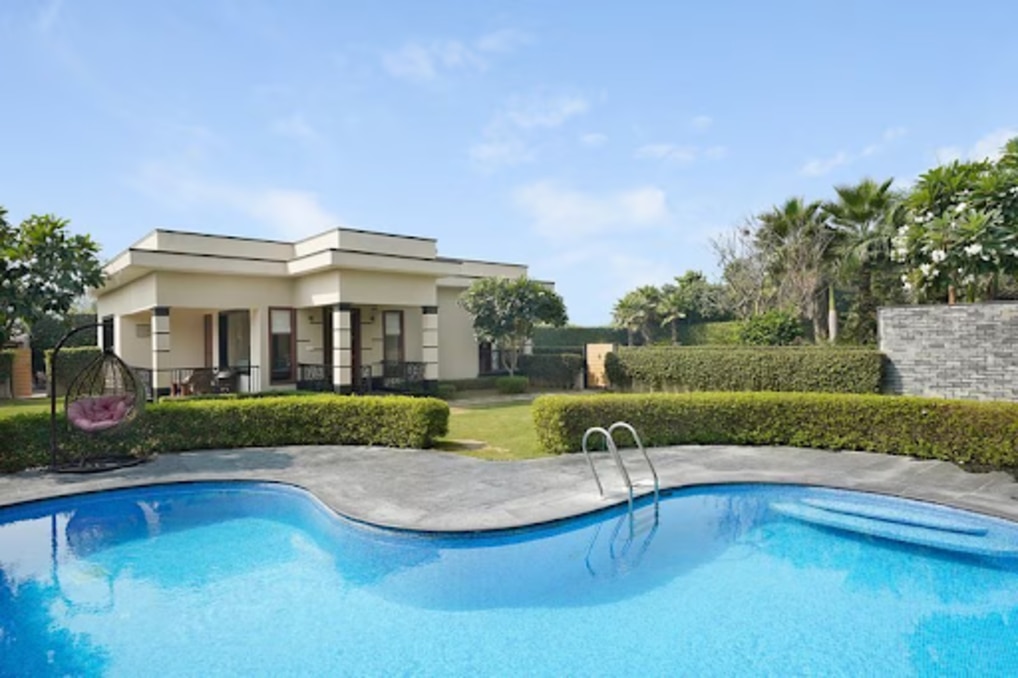
| Freeform | Landscape-led entertaining areas | Curves reduce usable swimming length and increase shell and cover complexity |
| Plunge-style | Cooling off, sitting, and small gatherings | Not suitable for lengths or large groups; reserve generous deck instead |
| Lap-style | Regular swimming exercise | Needs a straight, unobstructed length of about 10–12 m |
| Infinity-edge | Sloping sites or a strong distant view | Adds structural, balance-tank, pump, and water-loss demands; it is decorative, not a swimming requirement |
For sitting, children, and casual use, choose a compact 5 m × 3 m or 6 m × 3 m pool with clear non-slip deck around it. A lap pool should spend its area on length rather than islands or irregular shallow ledges.
Set recreational water depth around 1.2–1.35 m unless an engineer designs a dedicated diving zone. Steps, variable depths, and tanning ledges make a typical farmhouse pool non-diving. Confirm the farmhouse pool selection only after checking bather numbers, deck space, shade, maintenance access, and your willingness to manage evaporation and treatment.
Adapt the design to Nagpur’s soil, weather, water, and trees
Put the pool on the highest practical part of the site, away from natural drainage paths and large tree roots.
A farmhouse swimming pool design in Nagpur should keep a clear route from the house to the deck, with non-slip circulation space, an outdoor shower, changing area, plant-room access, and deck falls directed away from the shell.
Use shade to control Nagpur’s intense summer heat without placing heavy leaf or root loads over the water. A pergola, shade sail, or well-spaced tree canopy is easier to manage than dense planting beside the pool. Add a cover to reduce evaporation and solar heat gain.
Have the site investigation check:
- Black-cotton soil and seasonal expansion, which can crack shells and decks
- Uncontrolled fill or weak strata requiring undercutting and engineered fill
- Groundwater and monsoon water levels around the excavation
- Existing tree roots, which can disturb paving, pipes, and shell movement
Keep independent movement joints between the reinforced-concrete shell and deck. This detail matters when soil moisture changes unevenly.
During monsoon, route stormwater to a separate drain instead of allowing dirty deck runoff into the pool. Provide a correctly sized balance tank or overflow arrangement; rainfall is not controlled make-up water.
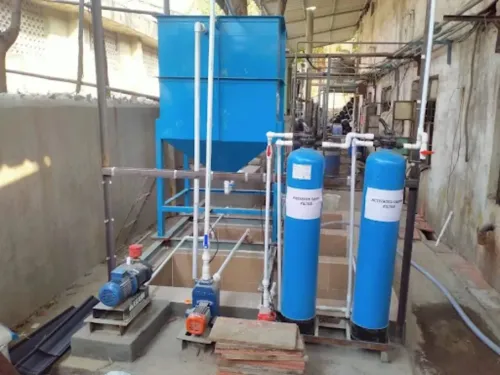
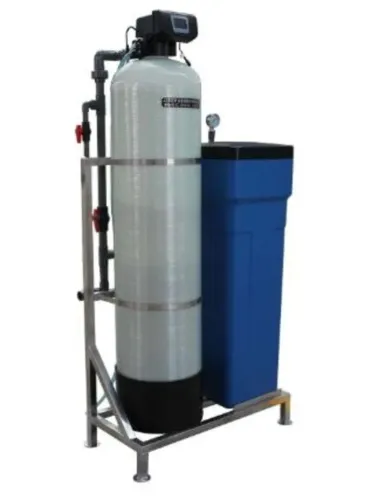
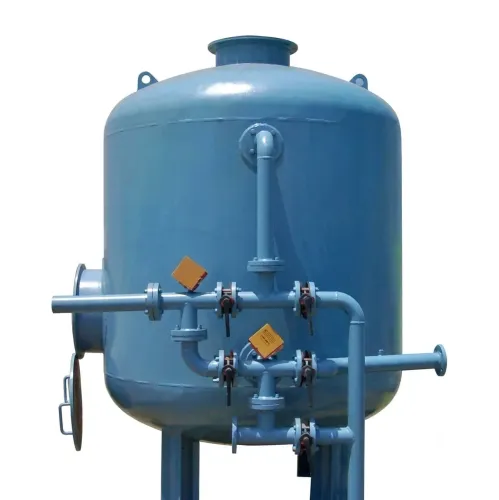
Specify filtration, design flow, turnover time, pressure gauges, backwash or cartridge-cleaning access, chemical storage, and drain routing. Test hard make-up water and dust loading before selecting automatic dosing. The best farmhouse pool size in Nagpur is the one your water supply and maintenance routine can support.
Compare concrete, FRP, and other construction approaches
Farmhouse pool selection should start with site access, not the shell catalogue. Measure the gate, turning radius, overhead wires, slope, and route from road to excavation; a crane may be needed for an FRP shell, while concrete needs sustained access for steel, formwork, concrete, and spoil removal.
| Option | Installation and access | Shape, repairs, durability |
|---|---|---|
| Concrete | Slowest; suits sites where materials enter in stages | Any shape and depth; structural cracks need diagnosis and repair; reinforced concrete lasts well when soil movement, waterproofing, and joints are properly detailed |
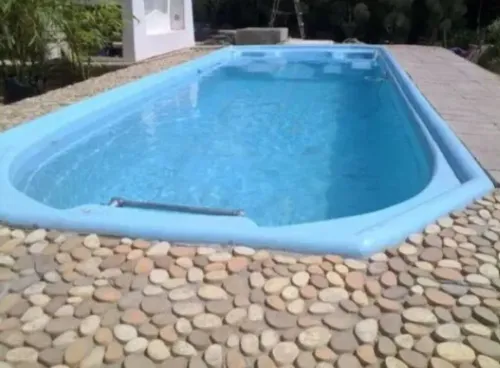
| FRP | Fast once the excavation and base are ready; requires delivery and crane access | Factory shape limits custom curves; surface and plumbing damage can be repaired, but colour matching is difficult; strong shell, yet backfill and support must be correct |
| Liner or panel construction | Faster than cast concrete; panels and rolls need less heavy access | Flexible layouts; liner punctures and fading mean replacement; steel or composite panels need inspection for corrosion and movement |
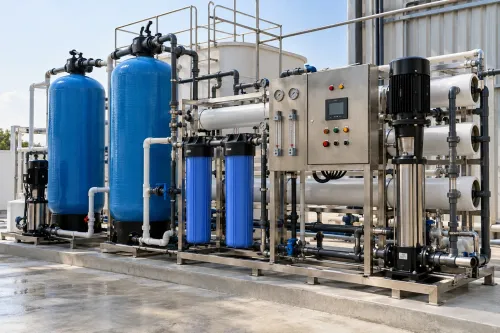
For farmhouse pool options in Nagpur, ask for a filtration schedule, not only a chlorinator: filter type and media, design flow, turnover time, backwash or cartridge-cleaning method, pressure gauges, air-release points, drain and waste routing, chemical storage, and locally available replacement media and parts.
Sand or media filters handle debris but use water during backwash; cartridges save that water but need manual cleaning.
Add a cover to reduce evaporation, dust, chemical demand, and heat loss. Venkatesh Hydro Technologies can help match shell access, filtration, and replacement-part availability before you approve the design.
Reserve the space that keeps filtration and maintenance practical
Add the deck and service route before approving the water rectangle: reserve a non-slip circulation deck, a plant room, and clear maintenance access. A compact pool without these areas becomes difficult to clean, repair, or use safely.
Keep the pump and filter close to the pool to limit long suction lines and sharp bends. Provide accessible isolation valves, unions, pressure gauges, air release, ventilation, and a floor drain; leave enough clearance to remove the filter lid and service the pump.
Keep electrical equipment separate from chemical storage, and place the room above monsoon runoff and groundwater levels.
Plan drainage before paving. Slope the deck away from the pool and house toward a trench drain or approved collection point, so Nagpur’s rainwater does not carry soil into the pool or flood the plant room. Add a safe route from the farmhouse, plus an outdoor shower and changing space.
Include these items in the drawing:
- Deck space for walking, loungers, cleaning equipment, and safe entry
- Overflow channel and balance tank for a perimeter-overflow pool
- Skimmer access and a main drain for a conventional pool
- Waste or backwash piping routed to an approved discharge point
- Cover storage and a design that prevents cover entrapment hazards
There is no single best farmhouse pool size in Nagpur. A 5 m × 3 m pool with generous deck, shade, cover, and automatic dosing can outperform a larger pool with no service space. Compare farmhouse pool options in Nagpur by total occupied area, not water dimensions alone.
Frequently asked questions
What is the best farmhouse pool size in Nagpur?
For most Nagpur farmhouses, 8 m × 4 m balances family swimming space with manageable land consumption. At a uniform 1.2 m depth, it holds about 38.4 m³ before steps and slopes.
What should you decide before choosing pool features?
Choose the pool shape and water depth first. These decisions determine usable swimming space, excavation requirements, circulation, and the suitability of features such as steps, lighting, and water elements.
Which local conditions affect farmhouse pool design in Nagpur?
Account for Nagpur’s soil, hot weather, monsoon rainfall, available water, drainage, and nearby trees. These factors affect excavation, waterproofing, water replacement, shading, and root protection.
Which pool construction options can you compare?
Compare reinforced-concrete pools, FRP pools, and other construction approaches by site access, shape flexibility, installation time, durability, repairs, and long-term maintenance.
How much space should you reserve around a farmhouse pool?
Reserve space for circulation, deck access, filtration equipment, pipework, electrical access, chemical handling, and maintenance. A pool plan that uses every available metre makes servicing difficult.
Keywords